We have a new officemate. She is very cheerful. She is forever smiling. She is always ready with a laugh, and she is quick to apologize if she thinks she made a mistake. She is effusive in her thanks, and is always mindful not to offend anyone.
She is sooo creeping me out, I swear.
I think she’s the type who keeps resentments and ill feelings to herself. In short she gets my vote for Most Likely To Flip Out. One day when Ms. Chirpy-Cheep-Cheep cannot hold things inside anymore she’ll just lose the smile, grab a submachine gun, and start shooting people in the office. I hope I’m on client call when that happens.

Wednesday, November 15, 2006


Mandy and More!
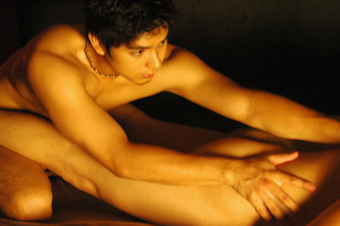 There’s this spa in QC that has a wet area that’s often full of PLUs on the prowl, but that’s not exactly why I go there. It’s this particular masseur named Mandy. First of all, he told me I could take off my shorts. Next he would glide his fingers ever so lightly along my inner thighs, reaching deeper and deeper until… bingo! His finger would oh so gently brush against my family jewels. And even when I was already sporting a raging hard-on, he didn’t mind letting his fingers stray along my pubic area. If I were in a massage parlor—you know, the Masahista kind—I would by that time be receiving some extra service, or in their parlance, “sensation.” But because this is not a “massage parlor” but a “spa” I decided not to risk it.
The second time I got Mandy, he got a little bolder. He engaged me in small talk, even revealing where he goes home and commenting on my living in Marikina, “Too bad it’s too far for me.” This time his fingers actually brushed this close to, uhm, a certain member of the McVie anatomy. Then when I was dressing up after the session, he said quietly, “Sir, next time maybe you want some sensation.” Jackpot! Bingo! Full house! Pong!
I smiled. “Next time,” I whispered back.
Next time I’ll be singing to myself, “Oh Mandy! Well, I came when you gave without taking. Then I sent you away, oh Mandy!”
Ang corny ng joke ko.
Monday, November 13, 2006
The Bitch Is (Come)Back!
Guess who’s making a “quiet” comeback in the McVie music charts? Why it’s Sir—or should I say, Dame?—Elton John! My top two tunes these days are: at number two, “I Don’t Feel Like Dancin’” by Scissor Sisters; and at number one, “In Private” by the Pet Shop Boys. So where’s Sir Elton, you ask? In the Scissor Sister’s track (which, by the way, they dubbed as “the happiest song in the world”) Sir Elton plays the piano, while in the PSB track he is the guest vocalist singing a duet with Neil Tenant.
Both songs can be heard on my McMultiply site under “Happy Music.”
Both songs can be heard on my McMultiply site under “Happy Music.”
Trick Or Drift
(The following is not a belated Halloween episode of The McVie Show.)
Watching Trick, the movie by Jim Fall starring Christian Campbell, J.P. Pitoc and Tori Spelling, can be, uhm, tricky when one is in a reflective mood. Actually most people will say “lonely” mood but I’d prefer “reflective” or better yet, “self-aware” mood. It’s all semantics, baby, yeah.
 Anyway, on to Trick. It’s structured like a classic Hollywood romantic comedy—two guys meet, they are attracted to each other, but people and circumstances converge to prevent the two from really hooking up, including the oh-so-needy-but-misunderstood-best-friend, but after several mix-ups and the prerequisite big confrontation and revelation scene, the two eventually declare their feelings, and eventually end up with a passionate on-screen kiss before movie fades to black. Roll end credits. Because everything is a cliché the movie is actually a tricky act to pull off successfully. But succeed it does. I mean, can anyone really believe that a guy as cute as Chris Campbell (wow, feeling ka-close na ako sa kanya! Er, he’s the one on the right in the picture below. John Paul Pitoc is the one on the left—he’s hot too!) can’t find someone interested in him? C’mon, pull our legs some more, puh-leez! But this is a rom-com, so you go with the flow. And the movie actually flows quite smoothly over those implausible spots. It even manages to end with a character launching into a song that continues over to the end credits roll.
 The problem with rom-coms is that they often fade out at a high and happy point. But life never stops at those high and happy moments. In fact they always are messier than what is shown onscreen. If one wants his life to end up like a Hollywood ending, then he should end his life after a particularly high point. Like maybe after finally getting the guy he’s going out with to agree to become his boyfriend, he should slash his wrists right there and then. Or after celebrating their fifth anniversary, a couple should just jump off a building. Of course in a Hollywood ending the fade out happens before the slashing or the jumping off.
 So it was a good thing that after watching Trick I immediately watched Drift, a movie by Quentin Lee, an Asian-Canadian gay filmmaker. It’s about Ryan and Joel, a couple who breaks up after three years. The lead character, Ryan, is an Asian American who feels that he’s just drifting in the relationship, so he calls everything off on the eve of their anniversary. The movie then effortlessly drifts into three alternative endings: one wherein Ryan replaces Joel with a crush he met when they were still a couple; another wherein Ryan and Joel get back together again; and a third wherein Ryan ends up alone but not regretting any of his decisions. All three endings are in their own way “happy” endings, but the audience also sees the compromises and the what-ifs and the trade-offs that accompany each so-called happy ending. By the third ending, the audience gets the drift: there really are no happy endings, but endings are as happy or as sad depending on how we make them to be—and depending on where the fade out happens.
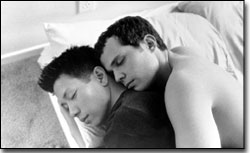
I’m glad I watched both films. Trick puts a smile in your face, while Drift puts that smile in its proper place.
(Both films can be found on VCD format at Top & Bottom, on top of O Bar, 1800 Orosa St. corner Nakpil Street, Malate, Manila.)
Watching Trick, the movie by Jim Fall starring Christian Campbell, J.P. Pitoc and Tori Spelling, can be, uhm, tricky when one is in a reflective mood. Actually most people will say “lonely” mood but I’d prefer “reflective” or better yet, “self-aware” mood. It’s all semantics, baby, yeah.
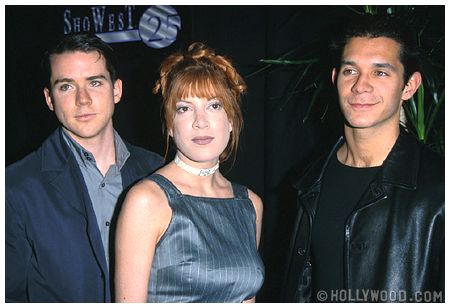 Anyway, on to Trick. It’s structured like a classic Hollywood romantic comedy—two guys meet, they are attracted to each other, but people and circumstances converge to prevent the two from really hooking up, including the oh-so-needy-but-misunderstood-best-friend, but after several mix-ups and the prerequisite big confrontation and revelation scene, the two eventually declare their feelings, and eventually end up with a passionate on-screen kiss before movie fades to black. Roll end credits. Because everything is a cliché the movie is actually a tricky act to pull off successfully. But succeed it does. I mean, can anyone really believe that a guy as cute as Chris Campbell (wow, feeling ka-close na ako sa kanya! Er, he’s the one on the right in the picture below. John Paul Pitoc is the one on the left—he’s hot too!) can’t find someone interested in him? C’mon, pull our legs some more, puh-leez! But this is a rom-com, so you go with the flow. And the movie actually flows quite smoothly over those implausible spots. It even manages to end with a character launching into a song that continues over to the end credits roll.
 The problem with rom-coms is that they often fade out at a high and happy point. But life never stops at those high and happy moments. In fact they always are messier than what is shown onscreen. If one wants his life to end up like a Hollywood ending, then he should end his life after a particularly high point. Like maybe after finally getting the guy he’s going out with to agree to become his boyfriend, he should slash his wrists right there and then. Or after celebrating their fifth anniversary, a couple should just jump off a building. Of course in a Hollywood ending the fade out happens before the slashing or the jumping off.
  So it was a good thing that after watching Trick I immediately watched Drift, a movie by Quentin Lee, an Asian-Canadian gay filmmaker. It’s about Ryan and Joel, a couple who breaks up after three years. The lead character, Ryan, is an Asian American who feels that he’s just drifting in the relationship, so he calls everything off on the eve of their anniversary. The movie then effortlessly drifts into three alternative endings: one wherein Ryan replaces Joel with a crush he met when they were still a couple; another wherein Ryan and Joel get back together again; and a third wherein Ryan ends up alone but not regretting any of his decisions. All three endings are in their own way “happy” endings, but the audience also sees the compromises and the what-ifs and the trade-offs that accompany each so-called happy ending. By the third ending, the audience gets the drift: there really are no happy endings, but endings are as happy or as sad depending on how we make them to be—and depending on where the fade out happens.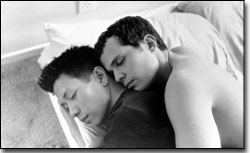
I’m glad I watched both films. Trick puts a smile in your face, while Drift puts that smile in its proper place.
(Both films can be found on VCD format at Top & Bottom, on top of O Bar, 1800 Orosa St. corner Nakpil Street, Malate, Manila.)
Friday, November 10, 2006
Winner Taxi Name
And now for something completely brainless: taxi-spotting! We spotted this taxi at our building’s driveway: “The Wheel of the Win.” Panalo! Pang-Spin A Win, hahaha!
Here Comes The Sun
From Shafts Of Sun:
reading your post, I kind of see where you're coming from, i just don't agree with it. basically, you're saying that the freedom of private business establishments to come up with their own rules within the confines of their own property as long as they don't violate the law (choosing who to let in) is more important than each person's individual liberty (how one wants to dress up). the problem with these two concepts is that basically they're both important, and should be respected up to a certain point. Re: cross-dressers and people wearing sandos not being allowed to go in certain establishments; the question becomes, do they cross the threshold where the importance of freedom of private establishments crosses over and infringes upon another person's liberty to express oneself? I would say yes, and, though not unlawful, at the very least enforces the idea that these people who choose to express themselves in this way cannot be trusted to behave themselves.
Re: the example of people not being allowed in city hall because they wear sandos; well, the whole thing is just, honest to God, unconstitutional. Last time I checked, this wasn't China. I'm actually surprised no one has brought it to court yet. The government has no power to discriminate against people especially on the basis of how they choose to dress themselves, and especially if the people who are going to be affected the most are those who need government help the most. Check Article III (Bill of Rights), XI (Accountability of Public Officers), and XIII (Social Justice and Human Rights) of the Constitution.
* * * * *
Thank you, Shafts Of Sun a.k.a. Polite Megalomaniac for your comments. You’ve made some very good points.
Let me just clarify something first. You stated: “you're saying that the freedom of private business establishments to come up with their own rules within the confines of their own property as long as they don't violate the law (choosing who to let in) is more important than each person's individual liberty (how one wants to dress up).”
I’m sorry but I never said that the freedom of establishments is “more important” than a persons individual liberty. Pardon me if I gave you that impression. I was just stating the sad reality that establishments justify their house rules as their means of protecting their business from “undesirable” customers. That’s why I asked the question “Why do certain establishments insist on a dress code in the first place?” twice. I wanted to thresh out the thinking behind dress codes and house rules.
I really like how you explained the delicate balance between the rights of the establishment versus the rights of individuals. In fact, the following statement of yours is pretty telling: “(it) enforces the idea that these people who choose to express themselves in this way cannot be trusted to behave themselves.”
The fear that flamboyantly cross-dressers as well as tattooed, leather-clad folks will behave embarrassingly is, I’d like to think, a fear born out of: [1] past bad experience/s; [2] passed-on or acquired bias; [3] the uncertainty of the unknown. Because there is no fool-proof way of screening queens who’ll behave appropriately versus queens who’ll behave badly (let’s not forget that what constitutes “bad” behavior is also subjective), is an establishment justified to impose a dress code/house rules as a preventive measure? Wow, talk about a preemptive strike.
Also, here a reality we have to consider: between a person exercising his freedom (wearing what he likes) versus an establishment exercising its house rules (including dress code), what often happens is that the person is the one ejected from the establishment. There are establishment that lend a dinner coat or jacket to customers who aren’t in the proper attire. How come the establishments get their way in most cases?
Re. the Marikina City Hall, I really don’t know why no one has questioned that rule yet. Maybe even the poorest of the poor in Marikina have at least one plain t-shirt? (I’m tempted to joke about them having shoes, but that’s just way too obvious.) Maybe the guards at the gate ask the people very gently and politely? Maybe the government—and the people—of Marikina doesn’t see it as discrimination, but teaching the people to be presentable? Maybe the rule isn’t as iron-clad as it sounds; maybe they do allow exceptions to the rule? I really don’t know.
I’ve never actually set foot in the City Hall, but my mom has and she was the one who told me about the rule. At first I was taken aback; isn’t that discrimination? But my mom told me how clean and orderly and behaved and—most importantly—disciplined the people were inside City Hall. (Or at least, that’s what it looks like on the surface; neither she nor I can attest that no under-the-table stuff happens inside.) Queues were orderly and properly observed; service was efficient, if a tad slow (not surprising). No one asked her for grease money to facilitate processing whenever she pays our real estate tax annually.
The cynic in me doesn’t believe that all is right in the Marikina City Hall. But I cannot deny that many Marikina residents attest to an improved City Hall; nay, to an improved city. They say there’s no arguing success; maybe that’s why no one has questioned the dress code. Yet.
reading your post, I kind of see where you're coming from, i just don't agree with it. basically, you're saying that the freedom of private business establishments to come up with their own rules within the confines of their own property as long as they don't violate the law (choosing who to let in) is more important than each person's individual liberty (how one wants to dress up). the problem with these two concepts is that basically they're both important, and should be respected up to a certain point. Re: cross-dressers and people wearing sandos not being allowed to go in certain establishments; the question becomes, do they cross the threshold where the importance of freedom of private establishments crosses over and infringes upon another person's liberty to express oneself? I would say yes, and, though not unlawful, at the very least enforces the idea that these people who choose to express themselves in this way cannot be trusted to behave themselves.
Re: the example of people not being allowed in city hall because they wear sandos; well, the whole thing is just, honest to God, unconstitutional. Last time I checked, this wasn't China. I'm actually surprised no one has brought it to court yet. The government has no power to discriminate against people especially on the basis of how they choose to dress themselves, and especially if the people who are going to be affected the most are those who need government help the most. Check Article III (Bill of Rights), XI (Accountability of Public Officers), and XIII (Social Justice and Human Rights) of the Constitution.
* * * * *
Thank you, Shafts Of Sun a.k.a. Polite Megalomaniac for your comments. You’ve made some very good points.
Let me just clarify something first. You stated: “you're saying that the freedom of private business establishments to come up with their own rules within the confines of their own property as long as they don't violate the law (choosing who to let in) is more important than each person's individual liberty (how one wants to dress up).”
I’m sorry but I never said that the freedom of establishments is “more important” than a persons individual liberty. Pardon me if I gave you that impression. I was just stating the sad reality that establishments justify their house rules as their means of protecting their business from “undesirable” customers. That’s why I asked the question “Why do certain establishments insist on a dress code in the first place?” twice. I wanted to thresh out the thinking behind dress codes and house rules.
I really like how you explained the delicate balance between the rights of the establishment versus the rights of individuals. In fact, the following statement of yours is pretty telling: “(it) enforces the idea that these people who choose to express themselves in this way cannot be trusted to behave themselves.”
The fear that flamboyantly cross-dressers as well as tattooed, leather-clad folks will behave embarrassingly is, I’d like to think, a fear born out of: [1] past bad experience/s; [2] passed-on or acquired bias; [3] the uncertainty of the unknown. Because there is no fool-proof way of screening queens who’ll behave appropriately versus queens who’ll behave badly (let’s not forget that what constitutes “bad” behavior is also subjective), is an establishment justified to impose a dress code/house rules as a preventive measure? Wow, talk about a preemptive strike.
Also, here a reality we have to consider: between a person exercising his freedom (wearing what he likes) versus an establishment exercising its house rules (including dress code), what often happens is that the person is the one ejected from the establishment. There are establishment that lend a dinner coat or jacket to customers who aren’t in the proper attire. How come the establishments get their way in most cases?
Re. the Marikina City Hall, I really don’t know why no one has questioned that rule yet. Maybe even the poorest of the poor in Marikina have at least one plain t-shirt? (I’m tempted to joke about them having shoes, but that’s just way too obvious.) Maybe the guards at the gate ask the people very gently and politely? Maybe the government—and the people—of Marikina doesn’t see it as discrimination, but teaching the people to be presentable? Maybe the rule isn’t as iron-clad as it sounds; maybe they do allow exceptions to the rule? I really don’t know.
I’ve never actually set foot in the City Hall, but my mom has and she was the one who told me about the rule. At first I was taken aback; isn’t that discrimination? But my mom told me how clean and orderly and behaved and—most importantly—disciplined the people were inside City Hall. (Or at least, that’s what it looks like on the surface; neither she nor I can attest that no under-the-table stuff happens inside.) Queues were orderly and properly observed; service was efficient, if a tad slow (not surprising). No one asked her for grease money to facilitate processing whenever she pays our real estate tax annually.
The cynic in me doesn’t believe that all is right in the Marikina City Hall. But I cannot deny that many Marikina residents attest to an improved City Hall; nay, to an improved city. They say there’s no arguing success; maybe that’s why no one has questioned the dress code. Yet.
Thursday, November 09, 2006
“What Is The Essence To Be A Gay?”
Benevolent judges, ladies and gentlemen, good evening!
Trying to define “homosexuality” and “gay” and thinking that the two words are synonymous will get you caught in a discussion that is still ongoing. Worse, terms such as “sexual orientation,” “sexual history” and “self-identification” are also thrown into the fray. I am not about to write a thesis, nor am I going to choose this topic should I decide to write a book.
I guess the simplest way I can define a homosexual person is this: if he is sexually and romantically attracted to people of the same gender, and if he identifies himself as such.
(Dear lesbians, for the sake of simplicity I just decided to limit my pronouns to “he” and my discussion to gay men, no offense meant of course.)
Which means that everything else—the fashion, the attitude, the loud behavior, the love for beauty contests, the tight-fitting muscle shirts, the impressive pecs, the cross-dressing, the discreet-acting—all that is relative and merely indicative of what most gay men appropriate for themselves, in their lifestyle, behavior, manners and values. At best these behaviors and manners are generalizations of what gay men are. Call them “circumstantial evidence,” so to speak.
Let me put it this way. Many New Yorkers are seen as pushy, aggressive, hurried people. That’s due to the effect of living in a fast-paced city. But not all New Yorkers are pushy, aggressive and hurried; likewise, not all pushy, aggressive and hurried people are New Yorkers.
Not all gay men should be discreet and straight-acting; in the same spirit, not all gay men should be loud and flamboyant. But gay men should have the freedom to choose to be discreet and straight-acting, or to be loud and flamboyant, or to be somewhere in between, or to be both depending on the occasion. The beauty of this “rainbow coalition” is that we should embrace all our differences, because the only thing that’s similar to us homosexuals is our sexual preference. We can view all other preferences as what makes us human, not just gay.
Taken to another level, gays and straights should be able to act any which way they want, whether conservative or flamboyant. It would be a wonderful world if we all can be tolerant with straight guys who sport Mohawks, leather jackets and tattoos as well as with flamboyant queens who parade in feathers and high heels.
Too idealistic? Impossible to achieve in this lifetime? I suppose. But there’s no harm in starting now.
And with that, I thank you benevolent judges. Bow.
Trying to define “homosexuality” and “gay” and thinking that the two words are synonymous will get you caught in a discussion that is still ongoing. Worse, terms such as “sexual orientation,” “sexual history” and “self-identification” are also thrown into the fray. I am not about to write a thesis, nor am I going to choose this topic should I decide to write a book.
I guess the simplest way I can define a homosexual person is this: if he is sexually and romantically attracted to people of the same gender, and if he identifies himself as such.
(Dear lesbians, for the sake of simplicity I just decided to limit my pronouns to “he” and my discussion to gay men, no offense meant of course.)
Which means that everything else—the fashion, the attitude, the loud behavior, the love for beauty contests, the tight-fitting muscle shirts, the impressive pecs, the cross-dressing, the discreet-acting—all that is relative and merely indicative of what most gay men appropriate for themselves, in their lifestyle, behavior, manners and values. At best these behaviors and manners are generalizations of what gay men are. Call them “circumstantial evidence,” so to speak.
Let me put it this way. Many New Yorkers are seen as pushy, aggressive, hurried people. That’s due to the effect of living in a fast-paced city. But not all New Yorkers are pushy, aggressive and hurried; likewise, not all pushy, aggressive and hurried people are New Yorkers.
Not all gay men should be discreet and straight-acting; in the same spirit, not all gay men should be loud and flamboyant. But gay men should have the freedom to choose to be discreet and straight-acting, or to be loud and flamboyant, or to be somewhere in between, or to be both depending on the occasion. The beauty of this “rainbow coalition” is that we should embrace all our differences, because the only thing that’s similar to us homosexuals is our sexual preference. We can view all other preferences as what makes us human, not just gay.
Taken to another level, gays and straights should be able to act any which way they want, whether conservative or flamboyant. It would be a wonderful world if we all can be tolerant with straight guys who sport Mohawks, leather jackets and tattoos as well as with flamboyant queens who parade in feathers and high heels.
Too idealistic? Impossible to achieve in this lifetime? I suppose. But there’s no harm in starting now.
And with that, I thank you benevolent judges. Bow.
Subscribe to:
Posts (Atom)